


Wisconsin Cray-1 Super Computer
Price range: $3.49 through $49.95
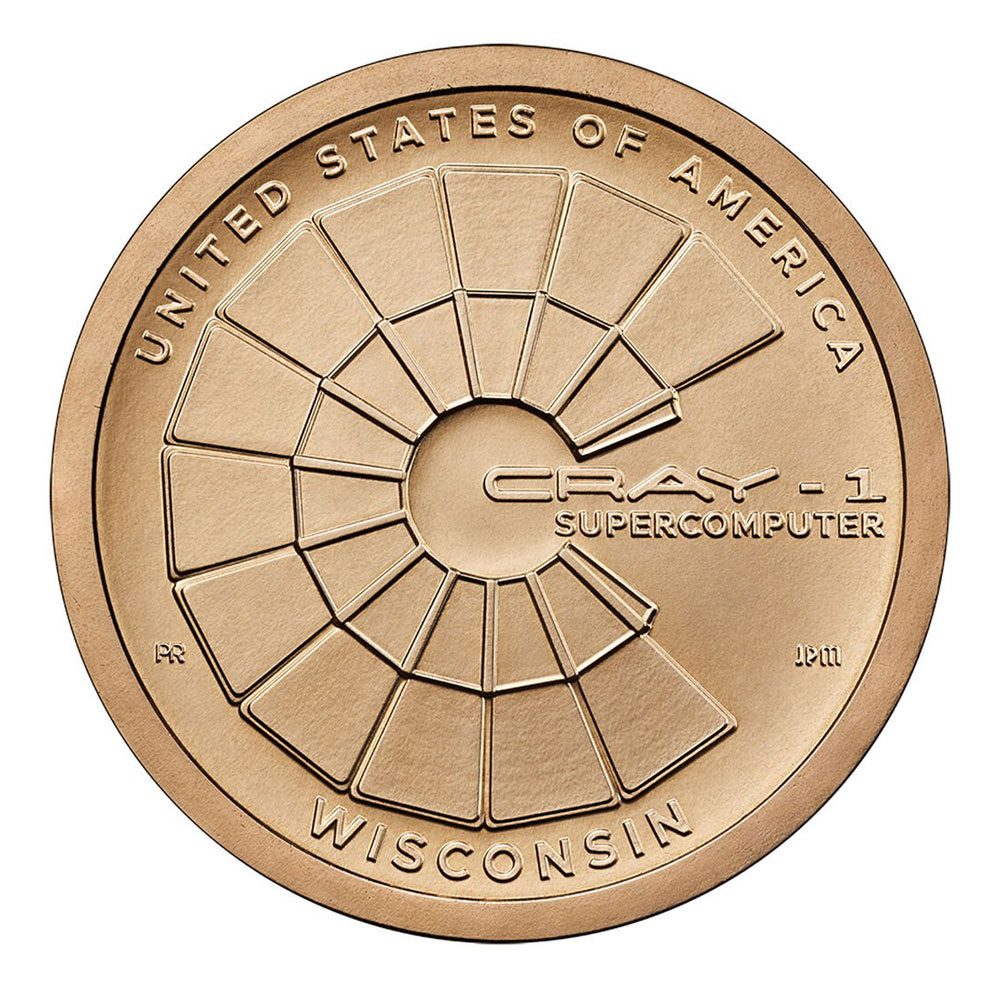
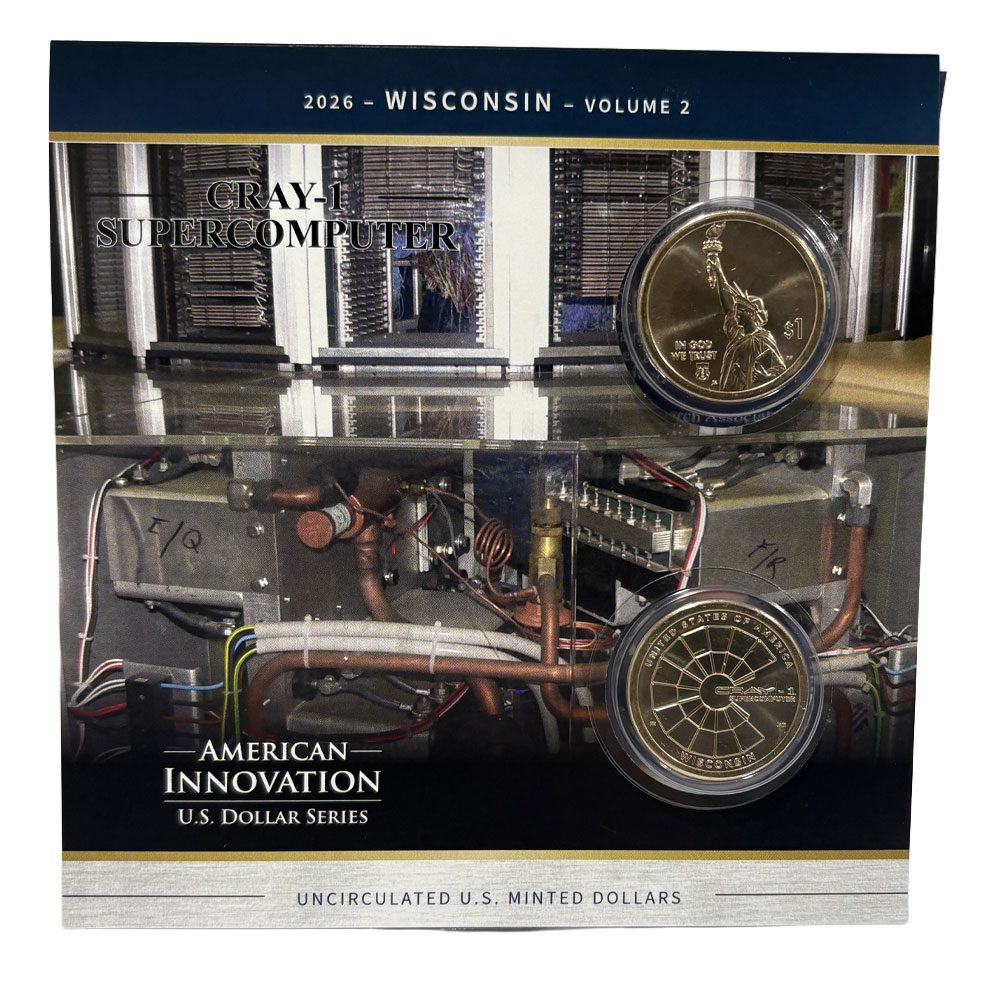
The Wisconsin American Innovation $1 Coin reverse (tails) design features the Cray-1, the first commercially successful supercomputer. Built from 1976 – 1982, it was known as the world’s fastest computer. The Cray-1’s unique circular design helped increase the speeds at which signals travel from one part of the computer to the other. This design exhibits a stylized aerial view of the Cray-1 supercomputer. The image emphasizes the Cray-1 not only through its shape, but by also suggesting the shape of a “C” for Cray-1 and “computer.” Inscriptions are “UNITED STATES OF AMERICA” and “WISCONSIN.” The additional inscription is “CRAY-1 SUPERCOMPUTER.”
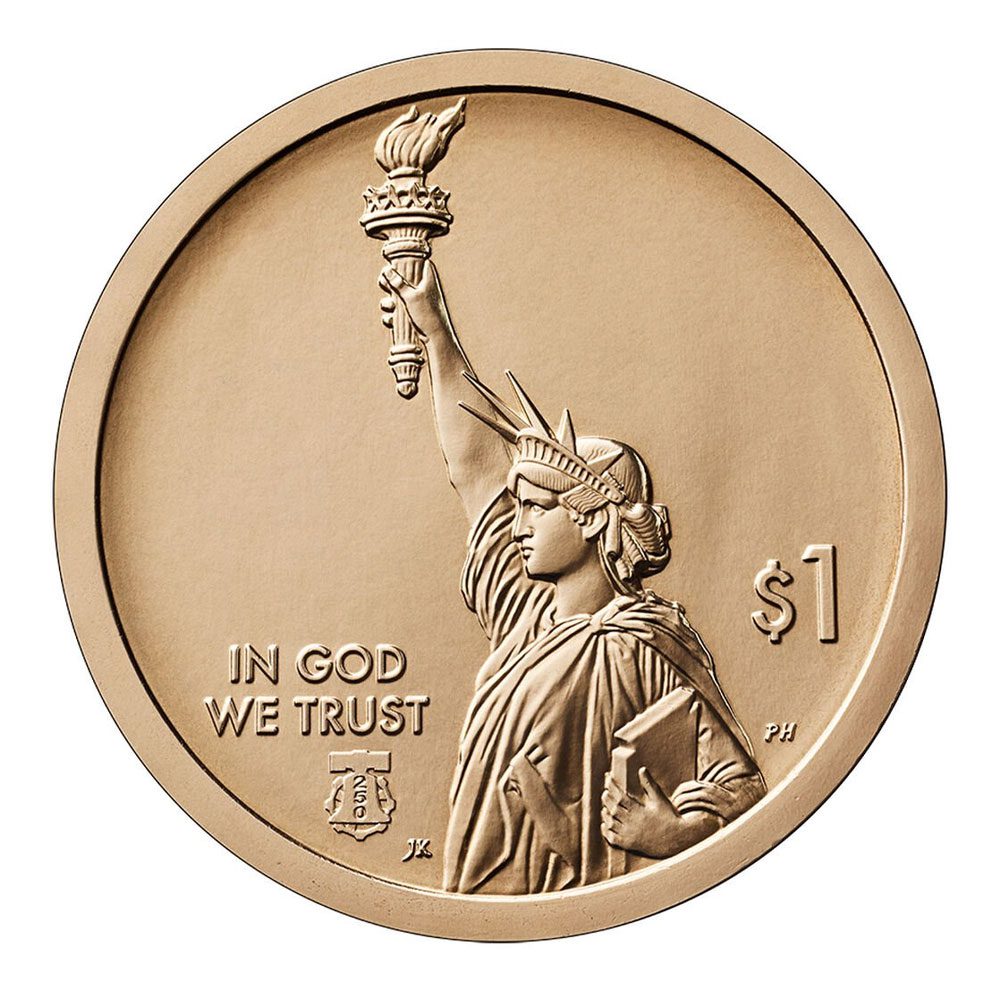
The obverse (heads) design features a dramatic representation of the Statue of Liberty in profile with the inscriptions “IN GOD WE TRUST” and “$1.” The design also includes a privy mark of a stylized gear, representing industry and innovation. In 2026, the privy mark will also incorporate a Liberty Bell with the inscription “250” to commemorate the semiquincentennial of our Nation’s founding.
Please select the Mint and the Packaging from the options below.
Product Description
The Cray1 Supercomputer: A Legendary Icon of High-Performance Computing
The Cray1 Supercomputer design featured in this product celebrates one of the most revolutionary machines in technological history. First introduced in 1976, the Cray1 forever changed scientific research, data modeling, cryptography, weather forecasting, and aerospace engineering through its unprecedented speed and distinctive engineering aesthetics. This stylized aerial rendering captures the supercomputer’s iconic C shaped form, a shape chosen not only for efficiency but also symbolic of “Cray” and “computer.” With inscriptions reading “UNITED STATES OF AMERICA,” “WISCONSIN,” and “CRAY1 SUPERCOMPUTER,” the design honors both the machine’s national significance and its creator’s Wisconsin roots.
Primary Design Description
This artwork features a refined, top down representation of the Cray1’s circular tower, a structure instantly recognizable to supercomputing enthusiasts. The shape was far more than a design choice—it was the result of Seymour Cray’s commitment to reducing wire length and improving system performance. The compact curve allowed engineers to pack dense arrays of circuit boards while ensuring the shortest possible pathways for electrical signals, a critical factor in achieving the Cray1’s extraordinary processing speed.
The stylized design emphasizes clarity, symmetry, and the flowing contours that defined the original hardware. This artistic interpretation preserves the essence of the machine while offering a clean, modernized aesthetic suitable for collectors, technologists, and design aficionados alike.
Design Symbolism & Technical Details
Just as the original Cray1 featured a ring of padded benches concealing its power supplies and cooling systems, this design abstractly incorporates those structural elements to highlight the clever engineering hidden beneath its elegant exterior. The computer’s shape also visually reinforces the idea of unity between hardware architecture and scientific ambition.
The curved form minimized wire lengths—more than 60 miles of wiring, hand assembled with no individual wire segment exceeding three feet, ran through the original Cray1’s body to minimize signal delay and boost performance. The design subtly references this complexity through layered radial patterns that hint at internal circuitry. [en.wikipedia.org]
This visual tribute blends technical innovation with artistic expression, capturing what made the Cray1 a masterpiece of both computing power and industrial design.
History of the Cray1 Supercomputer
The Cray1 emerged during a period when scientific institutions urgently needed faster computational capabilities. Designed by the legendary engineer Seymour Cray, often called the “father of supercomputing,” the system was first installed at Los Alamos National Laboratory in 1976, following intense competition between national research centers for access to this groundbreaking machine.
Built by Cray Research, founded in 1972, the Cray1 was engineered to overcome limitations found in earlier vector processing systems—machines like the CDC STAR100, which struggled to achieve practical performance despite theoretical advantages. The Cray1 succeeded by delivering vector processing in a highly optimized, efficient architecture, enabling it to run several times faster than comparable designs of its era.
Throughout the late 1970s and early 1980s, the Cray1 supported transformative work in:
- Weather forecasting and atmospheric modeling
- Nuclear and particle physics research
- Aircraft and aerospace design simulations
- Seismic analysis for energy exploration
- Cryptography and national security
Its influence was so significant that approximately 80 Cray1 systems were eventually sold, making it one of the most commercially successful supercomputers ever produced.
Technological Significance
The Cray1 achieved sustained performance around 160 MFLOPS, an extraordinary figure for its time, with short bursts reaching even higher speeds. This placed it firmly at the top of the computing world, where it remained the fastest supercomputer from 1976 to 1982.
Key innovations included:
- Advanced vector processing architecture enabling superior performance on large mathematical datasets
-
- Highly compact, curved chassis for minimal wire length and reduced signal delay
- Sophisticated cooling mechanisms using conduction and refrigerant flow systems
- Dense integrated circuits, setting new standards for supercomputer construction
Seymour Cray’s innovations radiated outward into future generations of high performance computing, including multiprocessor designs such as the Cray XMP and later liquid cooled systems like the Cray2.
Why This Product Matters: Collectible Appeal
This stylized Cray1 design makes an exceptional collectible for:
- Technology historians celebrating a milestone in computer engineering
- Supercomputing professionals who appreciate the origins of the field
- Design enthusiasts drawn to the Cray1’s timeless industrial form
- STEM educators and students exploring computing history
Much like the original machine, which became a symbol of scientific progress and human ingenuity, this product honors a system that permanently altered the landscape of technological capability.
Whether displayed in an office, research lab, classroom, or home collection, it serves as a striking conversation piece and a reminder of the moment when supercomputing stepped into the modern era.
You must be logged in to post a review.

Reviews